
GPT Image 2 vs Nano Banana 2.0: The Ultimate AI Image Generation Showdown
AI image generation is no longer just about creating "good-looking" visuals. The real competition now comes down to which model can actually understand prompts better, generate more usable outputs, and produce images that require less manual fixing afterwards.
With growing interest around the GPT Image 2 API and Nano Banana 2 API, many developers, creators, and marketing teams are now trying to determine which model delivers better results for actual production workflows instead of just showcase images.
In this comparison, we tested GPT Image 2 and Nano Banana 2.0 across multiple prompt scenarios including lifestyle photography, commercial advertising visuals, and text-heavy poster generation. We will compare image quality, prompt accuracy, realism, generation consistency, pricing, and API accessibility to see which model performs better in real-world usage.
What is GPT Image 2?
GPT Image 2 is OpenAI's latest AI image generation model, officially released on April 21, 2026. The model is built to generate images directly from natural language prompts and is part of OpenAI's expanding multimodal AI ecosystem.
Since launch, GPT Image 2 has become one of the most talked-about image generation models among creators, developers, and marketing teams exploring scalable visual content generation.
What is Nano Banana 2.0?
Following its release, Nano Banana 2.0 has increasingly been compared alongside newer image generation models such as GPT Image 2, especially among users exploring alternative AI image generation APIs and creative workflows.
Similarities Between GPT Image 2 and Nano Banana 2.0
Despite their different architectures, both GPT Image 2 and Nano Banana 2.0 support modern AI image generation workflows.
Natural Language Prompting
Both models can understand conversational prompts instead of relying only on short keyword-based instructions.
Text Rendering Support
Both GPT Image 2 and Nano Banana 2.0 are capable of generating readable text within posters, advertisements, menus, and branding materials.
Multiple Aspect Ratios
Both models support image formats such as 1:1, 9:16, and 16:9 for social media, banners, and cinematic content generation.
API Accessibility
The GPT Image 2 API and Nano Banana 2 API both allow developers and businesses to integrate AI image generation into creative workflows and applications.
Key Differences Between GPT Image 2 and Nano Banana 2.0
The biggest difference between GPT Image 2 and Nano Banana 2.0 is how both models approach image generation internally.
GPT Image 2: The "Thinking" Image Model
GPT Image 2 uses a reasoning-based generation approach where the model plans scene structure, lighting, spatial relationships, and composition before generating the final image.
This allows GPT Image 2 to perform particularly well in prompts involving:
- Complex layouts
- Object positioning
- Reflections and perspective
- UI mockups
- Text-heavy posters
- Structured compositions
Nano Banana 2.0: The Cinematic Generation Engine
Nano Banana 2.0 focuses more heavily on high-speed image generation and cinematic visual output rather than multi-step reasoning.
The model prioritizes:
- Cinematic lighting
- Atmospheric depth
- Photorealistic textures
- Vibrant color grading
- Visually expressive compositions
Precision vs. Visual Atmosphere
GPT Image 2 is more optimized for prompt precision and layout accuracy, while Nano Banana 2.0 focuses more heavily on visual mood, cinematic presentation, and artistic atmosphere.
Intent Fidelity vs. Creative Interpretation
GPT Image 2 generally follows prompts more strictly and accurately, especially for highly detailed instructions.
Nano Banana 2.0 tends to add more artistic interpretation and cinematic flair during generation, even when those details are not explicitly mentioned in the prompt.
Prompt Practices for GPT Image 2 and Nano Banana 2.0
Both models support natural language prompting, but they tend to respond differently depending on prompt structure and writing style. GPT Image 2 generally performs better with highly structured prompts containing detailed layout instructions, object positioning, and typography guidance, while Nano Banana 2.0 responds more naturally to prompts focused on mood, lighting, atmosphere, and cinematic styling.
GPT Image Prompt Guide Nano Banana 2 Prompt Guide
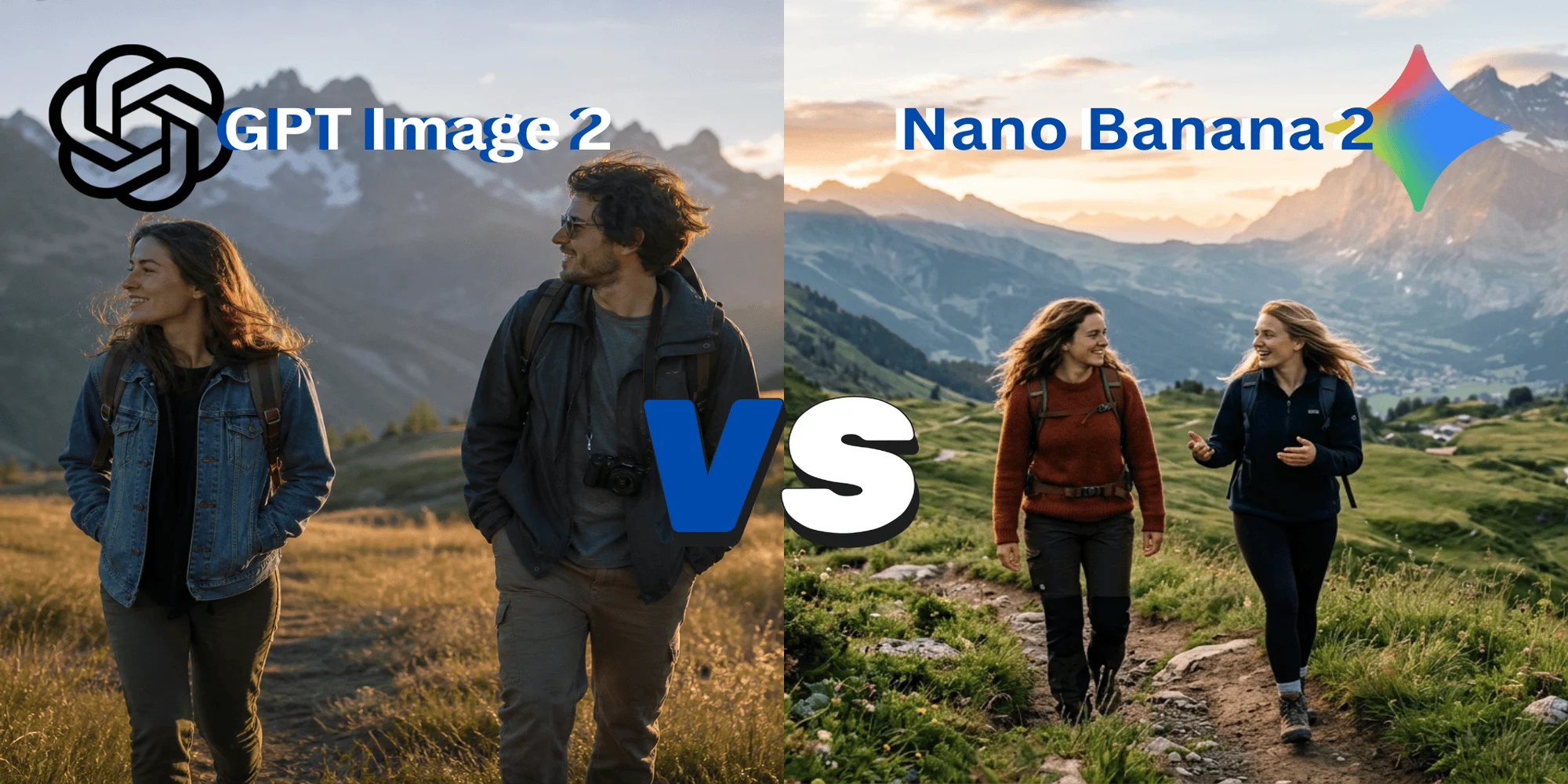
Example 1: Travel and Lifestyle Photography
Prompt:
A cinematic travel photograph of two friends walking through a mountain valley during sunrise, soft golden sunlight illuminating the landscape, natural candid poses, realistic skin texture, wind flowing through clothing and hair, lush greenery, atmospheric depth, ultra realistic photography, shallow depth of field, detailed environment, shot on 85mm lens, cinematic color grading, photorealistic
Comparison Analysis
For this travel photography prompt, the difference between GPT Image 2 and Nano Banana 2.0 becomes immediately noticeable once you examine how both models interpret realism and cinematic composition. GPT Image 2 approaches the scene more logically, carefully structuring spatial depth, lens compression, lighting direction, and environmental consistency before generating the final image. The result feels technically precise, especially in how the mountains, sunlight direction, and subject placement interact naturally within the scene.
Nano Banana 2.0, on the other hand, prioritizes atmosphere and emotional presentation over strict scene logic. The image delivers stronger cinematic mood straight out of generation, with richer environmental textures, more dramatic color grading, and a more organic-looking landscape overall. However, once inspected closely, smaller spatial inconsistencies within the terrain and background structure become more noticeable compared to GPT Image 2's more reasoned composition.
Overall, GPT Image 2 performs better in scene structure, lighting logic, and prompt fidelity, while Nano Banana 2.0 stands out more for cinematic atmosphere, environmental texture detail, and overall visual emotion.
Example 2: Commercial Product Advertisement
Prompt:
A premium matcha latte in a transparent glass cup placed on a minimalist concrete table, soft morning sunlight entering from the side, visible condensation on the glass, realistic foam texture, scattered matcha powder and bamboo whisk nearby, clean Japanese cafe aesthetic, shallow depth of field, cinematic food photography, ultra realistic, shot on 50mm lens, photorealistic
Comparison Analysis
The benchmark tests highlighted a very clear difference in how both models approach image generation. GPT Image 2 behaves more like a reasoning-based system, prioritizing spatial logic, prompt accuracy, typography placement, and structured composition before generating the final image. This was especially noticeable in the Mountain Valley and Tech Poster tests, where the model handled lens compression, lighting direction, layout hierarchy, and text rendering with much higher consistency.
Nano Banana 2.0, on the other hand, focuses more heavily on cinematic atmosphere and visual impact. The model produced stronger color grading, richer environmental textures, and more dramatic lighting straight out of generation, giving images a more organic and visually expressive feel. However, this came with weaker typography accuracy and less consistent spatial logic in more technically demanding prompts.
Overall, GPT Image 2 performed better in structured commercial design workflows and prompt fidelity, while Nano Banana 2.0 stood out more for cinematic presentation, speed, and aesthetic-driven image generation.
Example 3: Complex Spatial Reasoning and Reflection Scene
Prompt:
A modern dining table scene with exactly 7 objects arranged in specific positions: a red apple in the center, a glass cup to the left of the apple, a silver spoon placed diagonally above the cup, a folded newspaper on the right side of the apple, a black smartphone partially covering the newspaper, a lit candle behind the apple casting warm shadows forward, and a small mirror reflecting only the candle flame but not the apple. Cinematic indoor lighting, realistic reflections, accurate object spacing, realistic shadow direction, ultra realistic photography, shot on 50mm lens, photorealistic
Comparison Analysis
This final test exposed the clearest difference between GPT Image 2 and Nano Banana 2.0. GPT Image 2 handled the prompt with much stronger logical consistency, correctly following the exact object count, spatial positioning, reflection constraint, and shadow direction. The mirror reflection and lighting behavior especially demonstrated the advantage of its reasoning-based generation architecture.
Nano Banana 2.0 generated a more atmospheric and visually organic scene with stronger cinematic mood and environmental texture detail. However, the model struggled more with logical precision, introducing additional objects, less accurate reflection angles, and softer lighting behavior that prioritized aesthetics over physical consistency.
Overall, GPT Image 2 performed significantly better in complex reasoning and structured scene generation, while Nano Banana 2.0 remained stronger in cinematic atmosphere and visual storytelling.
Pricing and API Differences
At the time of writing, GPT Image 2 API pricing on PiAPI starts at $0.10/img per generation through the gpt-image-2-preview model. The model is currently positioned as a premium reasoning-focused image generation system, particularly for workflows involving typography, structured layouts, and complex prompt accuracy.
Nano Banana 2 API pricing is currently more resolution-based. Pricing starts at $0.06 per image for 1K generation, $0.08 for 2K, and $0.12 for 4K outputs. This makes Nano Banana 2.0 a more flexible option for users prioritizing high-volume generation, faster iteration, and scalable cinematic image workflows.
Both GPT Image 2 API and Nano Banana 2 API are available through PiAPI, allowing developers and businesses to integrate AI image generation directly into creative pipelines, applications, and automated production workflows.
Final Verdict
GPT Image 2 and Nano Banana 2.0 ultimately represent two very different approaches to AI image generation.
GPT Image 2 behaves more like a reasoning-driven image model. Its Chain-of-Thought architecture allows it to handle complex layouts, typography, reflections, object positioning, and structured prompts with significantly stronger logical consistency. For commercial workflows involving posters, UI mockups, advertisements, and technically demanding compositions, GPT Image 2 currently feels more reliable and precise.
Nano Banana 2.0, on the other hand, focuses more heavily on speed, cinematic atmosphere, and visual emotion. The model consistently produces striking color grading, organic lighting, and aesthetically rich imagery with minimal prompting, making it especially appealing for cinematic artwork, social media visuals, and creative ideation workflows.
Ultimately, choosing between GPT Image 2 and Nano Banana 2.0 depends on whether you prioritize logical precision or cinematic visual storytelling.