AI Face Rating Explained: What Face Scores and PSL Ratings Mean

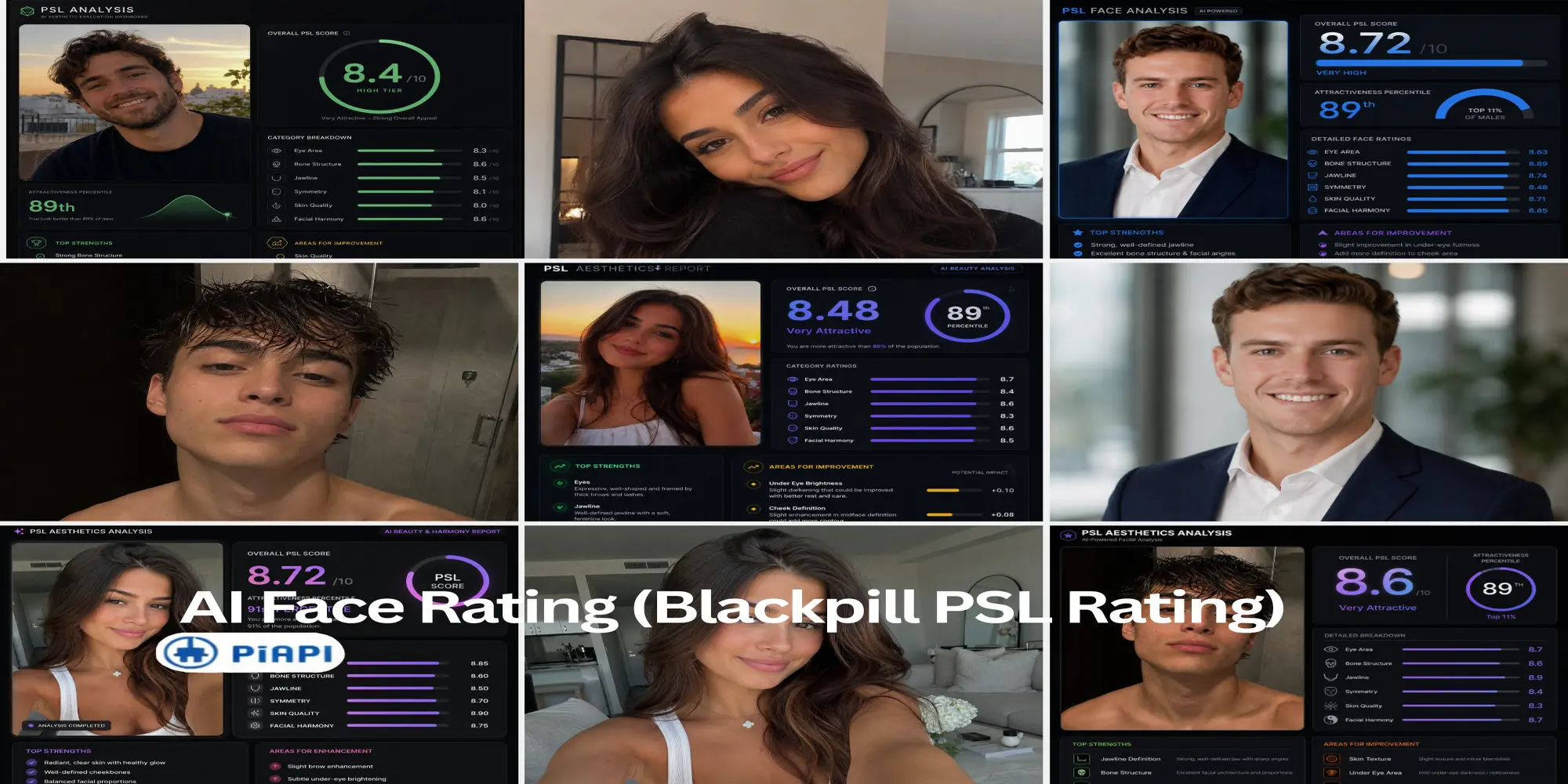
AI face rating has become one of those internet trends that sounds simple at first: upload a face photo, get a score, and see how the AI describes your facial features. But the language around it can get confusing fast. People search for face rating AI tools, PSL ratings, AI PSL ratings, face scores, and "how to rate my face with AI" as if they all mean exactly the same thing.
They are closely related, but the context matters. AI face rating is the broader idea. PSL rating and blackpill rating are face rating AI trends that spread through social platforms like TikTok and Instagram, usually with a stronger focus on perceived sexual appeal.
Quick answer: AI face rating is the use of AI to analyze a face photo and generate a score or report based on visible facial features such as symmetry, proportions, eye area, jawline, expression, and overall facial harmony. PSL rating is a social-media face-rating term that usually focuses more directly on perceived sexual appeal.
This guide explains what AI face rating means, why PSL face scores are trending, what these scores usually measure, and how to interpret them without treating a number as personal worth.
Key Takeaways
- AI face rating is the broad term for using AI to generate a face score or visual report from a photo.
- PSL rating and blackpill rating are social-media face scoring terms that spread through platforms like TikTok and Instagram.
- PSL and blackpill scores usually focus more directly on perceived attractiveness or sexual appeal.
- Face scores are subjective and can change based on image quality, camera angle, expression, and the tool's scoring system.
- The healthiest way to use face rating AI is as appearance or profile-photo feedback, not as a measure of personal worth.
Try the AI Face Rater
Try the face rating tool
Upload a selfie and generate an AI face rating report
Use the main AI Face Rater playground to upload a clear selfie and generate a visual report with face score, feature ratings, and appearance feedback.
Open the AI Face RaterWhat Is AI Face Rating?
AI face rating is a way to use artificial intelligence to review a face photo and return a score, breakdown, or visual report. A face rating AI tool might give one overall number, but stronger tools usually include category-level feedback as well.
For example, an AI face score may look at visible features such as:
- Facial symmetry
- Facial proportions
- Eye area
- Jawline and chin shape
- Cheekbones and facial contour
- Expression
- Overall facial harmony
Different AI face rating tools use different prompts, scoring systems, and visual styles. That means two tools can rate the same image differently. A score is not a universal truth; it is the output of a specific model, photo, and scoring approach.
What Is a PSL Rating?
A PSL rating is social-media language for rating a face, usually in terms of perceived sexual appeal. It is part of the same face rating AI trend that appears across TikTok, Instagram, and other short-form social platforms. In practice, it overlaps heavily with general face rating. People use terms like PSL score, PSL face score, face rating PSL, and AI PSL rating when they want a number or ranking that describes how attractive a face appears.
The key difference is the framing. General AI face rating can be broader and more constructive, especially when it focuses on facial features, profile-photo feedback, or visual presentation. PSL rating tends to be more blunt because the trend often reduces a face to a score.
That is why it is important to treat PSL-style scores carefully. They can describe how a photo or face is perceived in a certain online context, but they should never be treated as a complete judgment of a person.
AI Face Rating vs PSL Rating vs Blackpill Rating
These terms overlap, but they are usually used with different framing.
| Term | What it means | Common context | Best way to interpret it |
|---|---|---|---|
| AI face rating | AI-generated score or report based on visible facial features in a photo. | Face rating AI tools, profile-photo feedback, selfie review. | Treat it as appearance feedback from one image and one scoring system. |
| PSL rating | Social-media face rating term focused on perceived attractiveness or sexual appeal. | TikTok, Instagram, looks-focused communities, PSL score discussions. | Treat it as subjective trend language, not objective truth. |
| Blackpill rating | Face-rating term often used in the same communities as PSL, usually with a more negative tone. | Social-media rating content and blackpill/looks discussions. | Treat it carefully; the framing can be fatalistic and should not define personal worth. |
Why Are AI Face Ratings and PSL Scores Trending?
AI face rating, PSL scores, and blackpill rating are trending because they fit the way TikTok, Instagram, and other social platforms spread quick, visual, score-based content. A face score is easy to share, easy to compare, and easy to turn into a short video, screenshot, or reaction post.
There are a few reasons people search for this topic:
- They saw a PSL rating trend and want to know what it means.
- They want to check how a selfie or profile photo might be perceived.
- They are curious about facial symmetry, proportions, or "facial harmony."
- They want a glow-up, looksmax, or profile-photo feedback angle.
- They are looking for a simple way to rate their face with AI.
The AI face rating trend in 2026 is partly entertainment and partly self-review. Some users treat the score as a game. Others use it as feedback before changing a profile photo, dating app picture, creator avatar, or social media image.
What Does an AI Face Score Usually Measure?
An AI face score usually measures visible appearance signals in the uploaded image. The exact criteria depend on the tool, but most face rating systems focus on a similar set of categories.
| Category | What it usually means |
|---|---|
| Facial symmetry | Whether the left and right sides of the face appear balanced in the photo. |
| Facial proportions | How the spacing and size of visible features relate to each other. |
| Eye area | Eye visibility, balance, expression, and visual impact. |
| Jawline and chin | Lower-face shape, jaw definition, and chin balance. |
| Cheekbones and contour | Facial structure, cheekbone visibility, and contour. |
| Expression | Whether the expression looks natural, confident, tense, neutral, or unclear. |
| Overall facial harmony | How the visible features work together as a whole. |
| Photo clarity | Whether the face is clear enough for the AI to analyze. |
Photo clarity matters because a blurry, dark, filtered, or heavily angled image can change the result. But photo quality is not the same thing as facial appearance. A better-lit photo may receive a better score because the AI can read the face more clearly, not because the person has changed.
Example: What an AI Face Rating Report Can Look Like
Input image

Output image
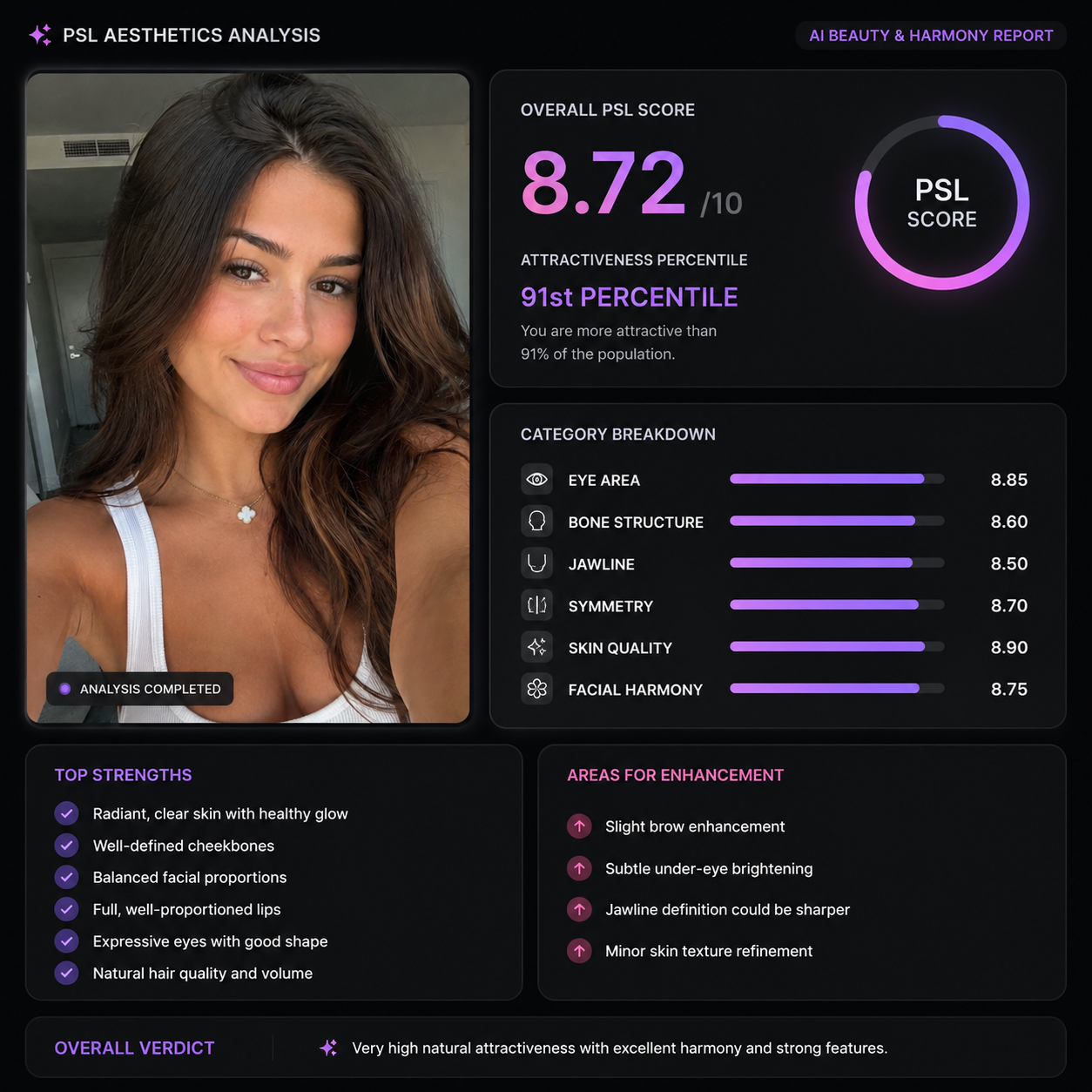
Here is a simple example of the product flow: one input selfie and one output image showing the generated AI face rating report.
Are AI Face Ratings Accurate?
AI face ratings can be useful for quick appearance feedback, but they are not perfectly accurate or objective. Results can change based on lighting, camera angle, expression, image quality, filters, and the scoring system used by the tool. If you want to compare reports more fairly, see our guide to why AI face rating scores change.
This is especially true for PSL-style ratings. A PSL face score often tries to compress many subjective signals into one number. That makes the result easy to understand, but also easy to overvalue.
The better way to read an AI face rating is to look beyond the headline score. Category notes are usually more useful than the number itself. If a report says the image has poor lighting, a tense expression, or an unclear angle, that is actionable. If it only gives a score with no explanation, it is mostly entertainment.
How to Interpret a Face Rating Without Overthinking It
A face score should never be treated as a measure of personal worth, health, identity, personality, or social value. It is a visual feedback signal, not a statement about who someone is.
Use AI face rating as a photo and appearance feedback tool:
- Look for patterns across the report, not just the final score.
- Treat the result as subjective, especially if it uses PSL language.
- Avoid comparing yourself harshly against other people.
- Do not use face scores to shame, rank, or harass anyone.
- Use your own photos or images you have permission to analyze.
If you want practical value from a face rating, focus on the parts you can actually use: clearer photos, better expression, cleaner framing, and a more readable profile image.
How to Try an AI Face Rating Report
If you want to try the face-rating trend with an AI-generated visual report, use PiAPI's AI Face Rater.
PiAPI's AI Face Rater is designed to turn a selfie into a visual face rating report. Instead of only returning a number, the report can include a face score, feature ratings, strengths, and improvement notes. Use it as facial feature feedback, not as a final judgment of attractiveness or personal value.
For the best result, upload one clear selfie where your face is visible. Avoid sunglasses, masks, heavy filters, group photos, and extreme angles so the AI can read the image more clearly.
AI Face Rating FAQ
What is AI face rating?
AI face rating is the use of AI to analyze a face photo and generate a score or report based on visible facial features such as symmetry, proportions, eye area, jawline, expression, and overall facial harmony.
What does PSL rating mean?
PSL rating is social-media language for rating a face, usually with a focus on perceived sexual appeal. It is closely related to general face rating, but the framing is often more direct and score-focused.
Is blackpill rating the same as PSL rating?
Blackpill rating and PSL rating are often used in the same online face-rating communities and social-media face rating AI trends. Both usually describe a face score focused on perceived attractiveness or sexual appeal, and both can show up in TikTok or Instagram-style rating content. The difference is mostly framing: PSL sounds like a scoring scale, while blackpill often carries a more fatalistic or negative tone. Either way, the score should be treated as subjective appearance feedback, not personal worth.
Is PSL rating the same as AI face rating?
Not exactly. PSL rating is a specific social-media face-rating trend, while AI face rating is the broader use of AI to score or analyze a face photo. A tool can generate a PSL-style score, but AI face rating can also include more constructive feature feedback.
What does a PSL face score measure?
A PSL face score usually tries to summarize perceived facial attractiveness or sexual appeal. It may consider visible features such as symmetry, facial proportions, jawline, eye area, cheekbones, expression, and overall facial harmony.
Is AI face rating accurate?
AI face rating can provide quick feedback, but it is not perfectly accurate or objective. Lighting, camera angle, image quality, expression, filters, and the tool's scoring system can all affect the result.
How can I rate my face with AI?
You can rate your face with AI by uploading a clear selfie to an AI face rating tool and generating a score or report. For a visual report with feature feedback, try PiAPI's AI Face Rater.
Can an AI face score judge my personal worth?
No. An AI face score should never be treated as a measure of personal worth, identity, health, personality, or social value. It is only a visual feedback signal based on a specific image and scoring system.