

MiniMax H3 Explained: Open-Weight Video Model
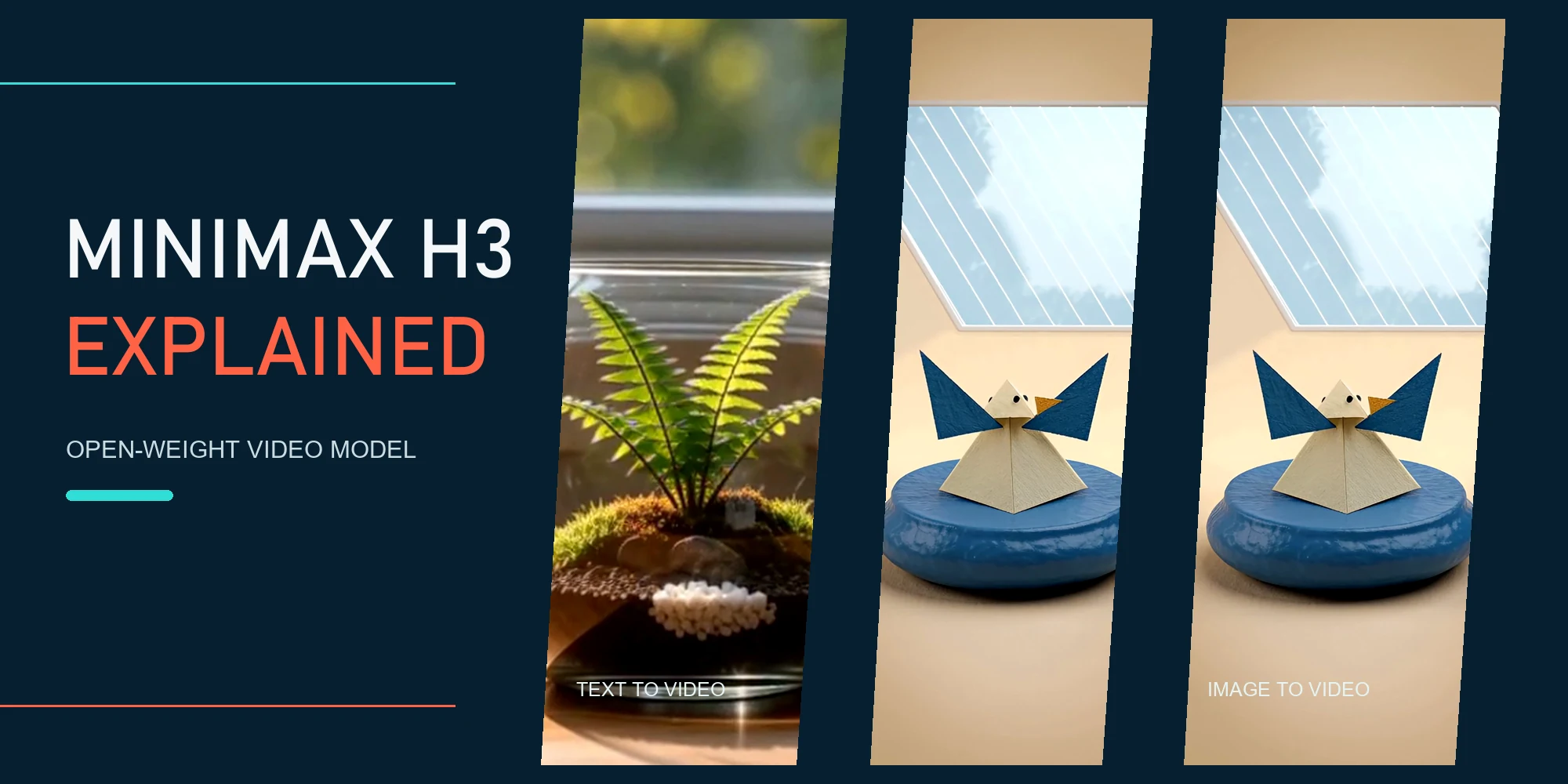
MiniMax H3 is a video-generation model from MiniMax that combines multimodal input understanding with generated video and native audio. The upstream release makes model resources publicly available under the MiniMax H3 Community License Agreement, so open-weight is more precise than simply "open-source." Through PiAPI, developers can use a managed endpoint for short text-to-video and first-frame image-to-video generation without setting up a local model environment.
The short version: MiniMax H3 is worth trying when low-cost iteration and native audio matter. Its results are promising for short-form concepts and early creative exploration, but exact text, complex scenes, and brand-sensitive compositions still need human review.
What is MiniMax H3?
MiniMax H3 is MiniMax's video-and-audio generation model. The upstream H3 release is broader than any single hosted API integration may be: MiniMax's materials discuss multimodal understanding, native stereo audio, and higher-end output capabilities. Those claims should not automatically be treated as features of every third-party endpoint.
PiAPI provides one practical access path through an asynchronous task API. Its current documented scope is narrower: txt2video for prompt-based generation and img2video for animating a supplied first frame, with 512p or 768p output, requested durations from 5 to 15 seconds, three aspect ratios, and native stereo audio in the returned MP4. For request bodies, polling, and implementation code, see the MiniMax H3 API guide.
Why are developers and creators paying attention?
MiniMax H3 sits at an interesting intersection. The public-weight ecosystem attracts developers who want to understand or experiment with the model beyond a closed web interface. Native audio makes the output useful for quick concept work because a clip can arrive with video and an audio stream in one file. PiAPI adds a managed route for teams that want to test prompts and workflows without first operating local inference infrastructure.
The cost also makes iteration practical. At the currently documented PiAPI rates, a five-second generation costs $0.15 at 512p or $0.25 at 768p. That does not make H3 automatically the cheapest or best model for every use case, but it lowers the cost of exploring several short concepts before a more expensive production pass.
Is MiniMax H3 open source?
Open-weight is the safer term.
The downloadable H3 release is governed by the MiniMax H3 Community License Agreement, not an unrestricted open-source license. The agreement includes territorial, acceptable-use, distribution, attribution, and commercial-use conditions. Its default Applicable Territory excludes the United States, European Union, United Kingdom, and South Korea.
In practical terms, public weights do not automatically mean that anyone can self-host, redistribute, modify, or commercially deploy MiniMax H3 everywhere. Check the current license for your jurisdiction and use case. PiAPI is a separate hosted service, so the downloadable-model license should not be treated as a description of PiAPI’s own access terms or capabilities.
What does MiniMax H3 support through PiAPI?
PiAPI's current MiniMax H3 documentation exposes:
- Text-to-video through
txt2video. - First-frame image-to-video through
img2video. - 512p and 768p output.
- Requested durations from 5 to 15 seconds.
- 16:9, 9:16, and 1:1 aspect ratios.
- Native stereo audio and asynchronous task creation and polling.
Broader upstream references to 2K output, multi-shot generation, video-to-video, or additional reference modes should not be presented as PiAPI features unless the current MiniMax Generate Video API documentation confirms them.
Try MiniMax H3 through PiAPI
5s · 16:9 · Est. $0.15
How much does MiniMax H3 cost through PiAPI?
Based on PiAPI rates verified on August 13, 2026, a successful five-second task costs $0.15 at 512p or $0.25 at 768p. The two new tests generated for this article used those settings and consumed 1,500,000 and 2,500,000 PiAPI points respectively, for an expected $0.40 total. Prices can change, so check the current documentation before budgeting a larger batch.
How well does MiniMax H3 perform?
This article uses two new PiAPI outputs generated specifically for this review. The 512p terrarium text-to-video task completed successfully in 129.93 seconds. The terrarium remains the clear central subject and the restrained push-in is easy to follow, but the requested fern-unfurling detail is subtle at this short duration. That makes it a useful focused composition example, though not evidence that H3 will reproduce every small natural movement precisely.
The 768p paper-bird image-to-video task completed successfully in 150.41 seconds. The supplied bird-and-bowl composition remains recognizable while the model adds gentle motion, but the simple graphic source is interpreted with some visual softness and should be reviewed frame by frame before being treated as a controlled animation.
Together, the fresh outputs show a practical value proposition: H3 can produce inspectable short clips for focused scene exploration and first-frame animation at a low per-attempt cost. They also reinforce the need for review. Both files include video and audio streams, but stream presence alone does not establish audio quality, synchronization, or prompt adherence. This two-generation set is practical review evidence, not a benchmark.
Who should try MiniMax H3 through PiAPI?
MiniMax H3 is a sensible candidate for developers prototyping an asynchronous video workflow, creators iterating on short-form concepts, and product or lifestyle teams exploring motion directions before investing in final production assets. It is also useful for teams that want video and an audio stream returned together.
It is a weaker fit when typography must be exact, a brand asset must remain unchanged, a complex action must work on the first attempt, or a clip must publish without human approval. For a matched model-selection discussion, see the MiniMax H3 vs Seedance 2.0 comparison.
Conclusion
MiniMax H3 is compelling because it combines an open-weight ecosystem, native audio, and an inexpensive managed API path. Through PiAPI, developers can explore short text-to-video and image-to-video workflows at a relatively low per-generation cost. The tradeoff is that promising footage is not guaranteed footage: exact text, complex scenes, and brand-sensitive outputs still require review.
Ready to explore the model? Try MiniMax H3 through PiAPI, or read the MiniMax H3 API guide for the complete request and polling workflow.
Frequently asked questions
What is MiniMax H3?
MiniMax H3 is a MiniMax video-generation model with multimodal understanding and native audio. PiAPI currently exposes a managed subset for text-to-video and first-frame image-to-video.
Is MiniMax H3 open source?
Open-weight is the more precise term. The public release is governed by the MiniMax H3 Community License Agreement, which includes territorial and usage restrictions.
Does PiAPI support MiniMax H3 audio?
PiAPI documents native stereo audio in the returned MP4. Audio presence does not by itself prove that every requested sound or synchronization cue was followed accurately.
How much does a five-second MiniMax H3 generation cost?
At the rates verified on August 13, 2026, a successful five-second task costs $0.15 at 512p or $0.25 at 768p through PiAPI.
Can MiniMax H3 generate video from an image through PiAPI?
Yes. PiAPI documents first-frame image-to-video through the img2video task type. The current API guide covers the request format and polling flow.