
Seedream 5 vs Nano Banana 2 (2026) : quel modele d'IA est vraiment le meilleur ?
Si vous testez des modeles generatifs et que vous tombez souvent sur des rendus lents ou des resultats incoherents, vous avez probablement deja vu deux noms : Seedream 5.0 et Nano Banana 2. Les deux repoussent les limites de la generation d'images en 2026, mais ils adoptent des approches tres differentes en matiere de vitesse, de coherence et d'utilisation reelle en production.
Dans cette comparaison, j'ai teste Seedream 5 vs Nano Banana 2 sur la qualite de sortie, le respect du prompt, la vitesse, l'integration API et le prix. Si vous devez choisir un modele, cette analyse vous aidera a comprendre lequel tient vraiment ses promesses.
Qu'est-ce que Nano Banana 2 ?
Nano Banana 2 (Gemini 3.1 Flash Image) est le modele d'image rapide de Google, pense pour la production et la generation a grand volume.
Il genere des images en quelques secondes et prend en charge plusieurs resolutions, de l'apercu 0.5K jusqu'au 4K, ce qui le rend utile pour l'iteration rapide comme pour les sorties finales.
Sa force principale est la coherence. Vous pouvez verrouiller des images de reference avec jusqu'a 5 personnages et 14 objets, afin de garder des visuels stables sur plusieurs generations.
Il est aussi ancre dans la recherche, en s'appuyant sur Google Search et Images pour produire des visuels plus exacts et plus proches du monde reel, plutot que des resultats hallucines.
Il prend egalement en charge de nombreux formats, y compris des ratios extremes comme 1:8 et 8:1, et gere le texte multilingue ainsi que la mise en page de facon plus fiable que la plupart des modeles.
Qu'est-ce que Seedream 5 ?
Seedream 5.0 Lite est le modele de generation d'images de ByteDance, centre sur le raisonnement et les sorties structurees.
Sa force principale est le raisonnement Chain-of-Thought. Le modele planifie la scene avant de generer, ce qui l'aide a mieux gerer les logiques spatiales et les relations complexes.
Il se comporte aussi bien sur la precision culturelle, avec des visuels plus varies et moins centres sur une esthetique occidentale que beaucoup d'autres modeles.
Cote cout, Seedream 5 est plus efficace. Il coute environ 33 % moins cher sur PiAPI, ce qui en fait une option solide pour la production a grande echelle.
Similarites et differences entre les modeles
Meme s'ils visent des workflows proches, Nano Banana 2 API et Seedream 5 API partagent une base solide mais different dans leur execution. Les deux prennent en charge les sorties haute resolution, les prompts multimodaux et le web grounding, mais ils divergent dans leur facon de gerer la coherence, le raisonnement et le design.
Lequel choisir ?
vous avez besoin de sorties coherentes a grand volume, ou les personnages ou produits doivent rester identiques d'une generation a l'autre.
vous creez des visuels complexes et tres orientes design, ou la mise en page, la hierarchie et l'interpretation comptent plus que la vitesse.
Chaque exemple ci-dessous utilise le meme prompt pour les deux modeles afin de comparer directement leurs performances.
Exemple 1 : test de coherence produit
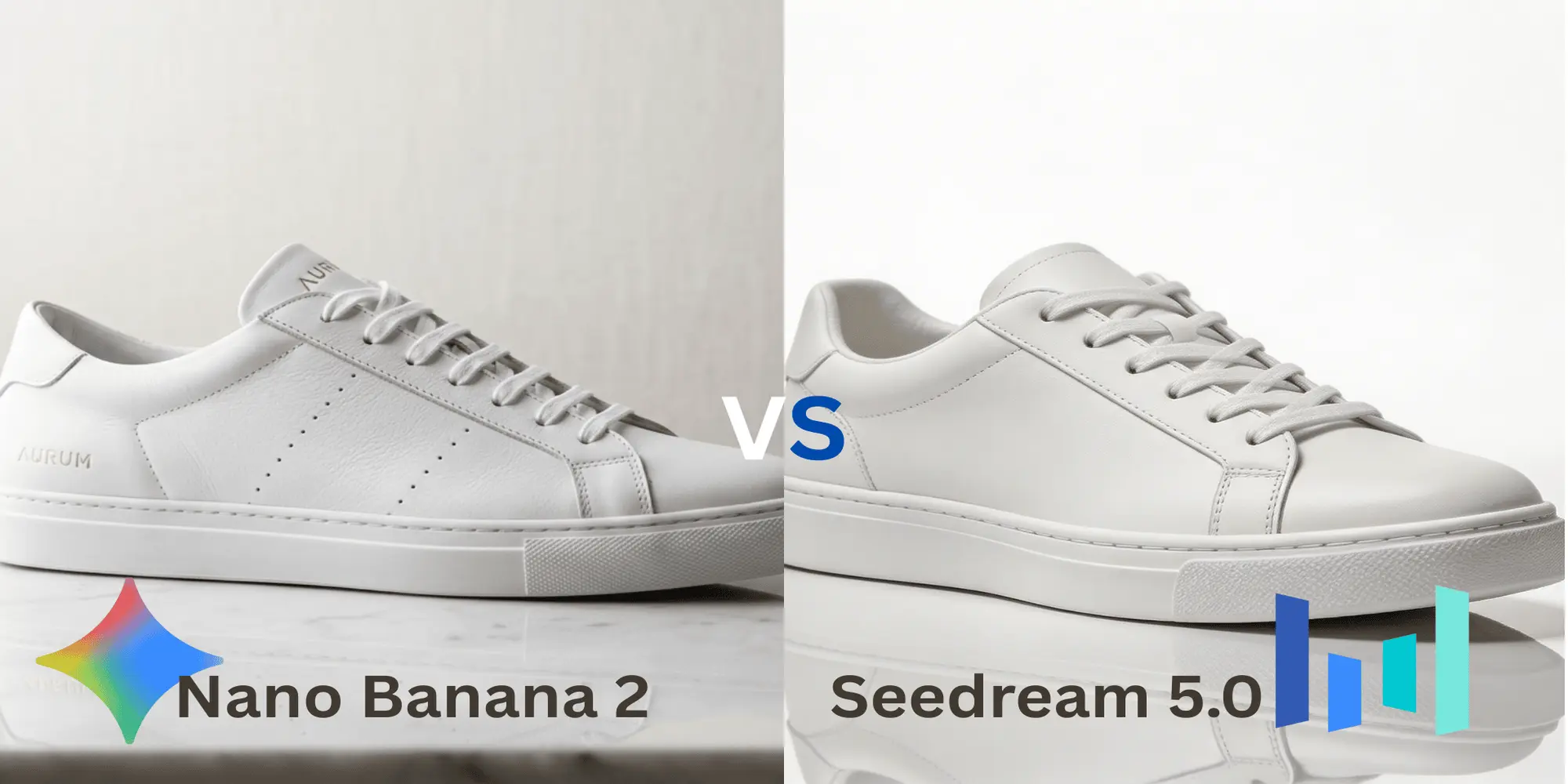
A premium product shot of a white sneaker with a minimalist design, placed on a reflective surface, soft studio lighting, clean background, luxury brand aesthetic, high detail
Evaluation
Les deux modeles suivent bien le prompt et produisent une image produit propre avec une esthetique premium. La difference devient nette sur le realisme et la qualite des materiaux.
Nano Banana 2 livre des textures tres realistes, avec un grain de cuir visible et des variations naturelles sur la chaussure. Les reflets et les ombres sont physiquement plausibles, donnant une sensation proche d'une vraie photo produit. Les details de marque restent aussi plus coherents.
Seedream 5 produit un resultat plus poli et plus stylise. L'eclairage est propre et agreable, mais les textures semblent legerement trop lissees, ce qui rapproche l'image d'un rendu 3D. Les reflets sont plus lumineux mais moins ancres physiquement, et les details de marque sont moins constants.
Globalement, Nano Banana 2 se distingue par un meilleur realisme et une meilleure precision produit, tandis que Seedream 5 tend vers un style visuel plus esthetique et directement exploitable.
Exemple 2 : test de mise en page et de raisonnement
A modern restaurant menu poster with a bold headline at the top, featured dish image in the center, price list aligned on the right, and a small logo at the bottom, clean typography, balanced layout, minimal design
Evaluation
Les deux modeles suivent bien le prompt et generent une mise en page de type menu structuree. La difference apparait surtout dans la precision d'alignement et la gestion des designs riches en texte.
Nano Banana 2 produit un resultat tres structure, avec un alignement precis des elements. Le titre, l'image centrale et la liste de prix a droite sont places comme demande, ce qui donne une mise en page proche d'un rendu pret pour la production. Il gere aussi beaucoup de texte avec une bonne lisibilite et une hierarchie claire.
Seedream 5 produit une mise en page plus propre et plus minimale, mais l'alignement est moins strict. Les elements semblent un peu plus flottants et la structure generale est moins rigide. La typographie reste lisible, mais il y a moins d'elements et de petites incoherences, avec une priorite donnee a la simplicite visuelle plutot qu'a la densite d'information.
Globalement, Nano Banana 2 se distingue sur les mises en page structurees, riches en texte et alignees avec precision, tandis que Seedream 5 tend vers un style plus minimal et esthetique.
Exemple 3 : test de precision dans le monde reel
A busy street scene in Singapore with MRT signage, modern buildings, pedestrians walking, warm sunset lighting, realistic environment, high detail
Evaluation
Les deux modeles generent une scene de rue urbaine animee avec une forte qualite visuelle. La difference devient claire sur l'exactitude factuelle et la localisation.
Nano Banana 2 produit un resultat tres realiste et precis pour le lieu. L'environnement ressemble davantage a de vraies rues de Singapour, avec une signaletique MRT correcte, des styles de batiments reconnaissables et du texte multilingue mieux rendu. Les details comme les panneaux et l'infrastructure restent coherents avec des references du monde reel.
Seedream 5 produit une scene visuellement agreable, mais plus proche d'une ville asiatique generique. L'eclairage et la composition sont solides, mais certains elements manquent de precision, notamment une signaletique qui ne correspond pas totalement au design reel du MRT de Singapour. Les details multilingues sont aussi moins constants.
Globalement, Nano Banana 2 se distingue par la precision du monde reel et la localisation, tandis que Seedream 5 se concentre davantage sur le style et l'atmosphere.
Tarification
Nano Banana 2 utilise une tarification fixe par image selon la resolution :
1. 1K - $0.06 per image
2. 2K - $0.08 per image
3. 4K - $0.12 per image
Seedream 5.0 Lite est propose a un tarif plus competitif :
1. 2K (default) - $0.052 per image
2. 3K - $0.052 per image
Globalement, Seedream 5 est nettement moins cher, surtout pour la generation a grande echelle, tandis que Nano Banana 2 se positionne comme une option plus couteuse et plus axee sur la performance.
Pricing is accurate at the time of writing. For the latest updates, refer to the Nano Banana 2 API docs and Seedream 5.0 API docs .
Verdict final
Nano Banana 2 et Seedream 5 sont tous deux des modeles de premier plan en 2026, mais ils sont concus pour des objectifs tres differents.
Nano Banana 2 se distingue par sa vitesse, sa precision et son exactitude dans le monde reel. Il fonctionne de facon constante sur les photos produit, les mises en page structurees et les scenes basees sur un lieu, ce qui en fait le meilleur choix pour la production a grand volume, la localisation et les taches qui exigent un controle precis.
Seedream 5, de son cote, se concentre sur le raisonnement et le design. Il gere plus naturellement la mise en page, la composition et le style visuel, ce qui en fait une bonne option pour les travaux creatifs ou l'interpretation et l'esthetique comptent plus que la stricte exactitude.
En bref, Nano Banana 2 est le modele le plus fiable et le plus pret pour la production, tandis que Seedream 5 convient mieux aux usages creatifs et orientes design.
Start testing Nano Banana 2 and Seedream 5.0 via PiAPI today!
Unlock the power of 20+ AI models with PiAPI - image, video, chat, music, and more. Sign up today and start building smarter, faster and at scale.